Repentance: The Biblical Mandate for Radical Reorientation – A Comprehensive Theological and Linguistic Examination of Shuv, Nacham, Metanoia, and Epistrophe Across the Canon of Scripture
Source: raw/Repentance_ The Biblical Mandate for Radical Reorientation.pdf
The concept of repentance occupies a position of unparalleled centrality in the sacred text, functioning not as an optional addendum to faith or a preliminary emotional stage in the ordo salutis, but as the indispensable, Spirit-wrought reorientation of the entire human person—mind, will, affections, and conduct—toward the living God. In an era when the term has been evacuated of its scriptural force and reduced either to transient feelings of regret or to external behavioral adjustments detached from ontological transformation, a return to the precise lexical, contextual, and theological data of both Testaments is urgently required. Such an examination equips those who belong to the body of Christ to walk in genuine newness of life while simultaneously rendering the unregenerate without excuse, for the biblical witness makes plain that true repentance is neither humanly achievable by unaided effort nor safely postponed without eternal peril.
This study proceeds through exhaustive lexical analysis of the primary Hebrew and Greek terms, detailed exegesis of paradigmatic passages, integration of prophetic, apostolic, and psalmic witnesses, and a sustained demonstration of what repentance both is and is not. Every relevant occurrence and semantic nuance will be brought to bear so that the reader may perceive the unified yet progressively revealed pattern: repentance is the death of the old orientation and the emergence of Spirit-given life, grounded in the person and work of the Messiah and applied by the Holy Spirit within the called-out assembly.
Visual Companion
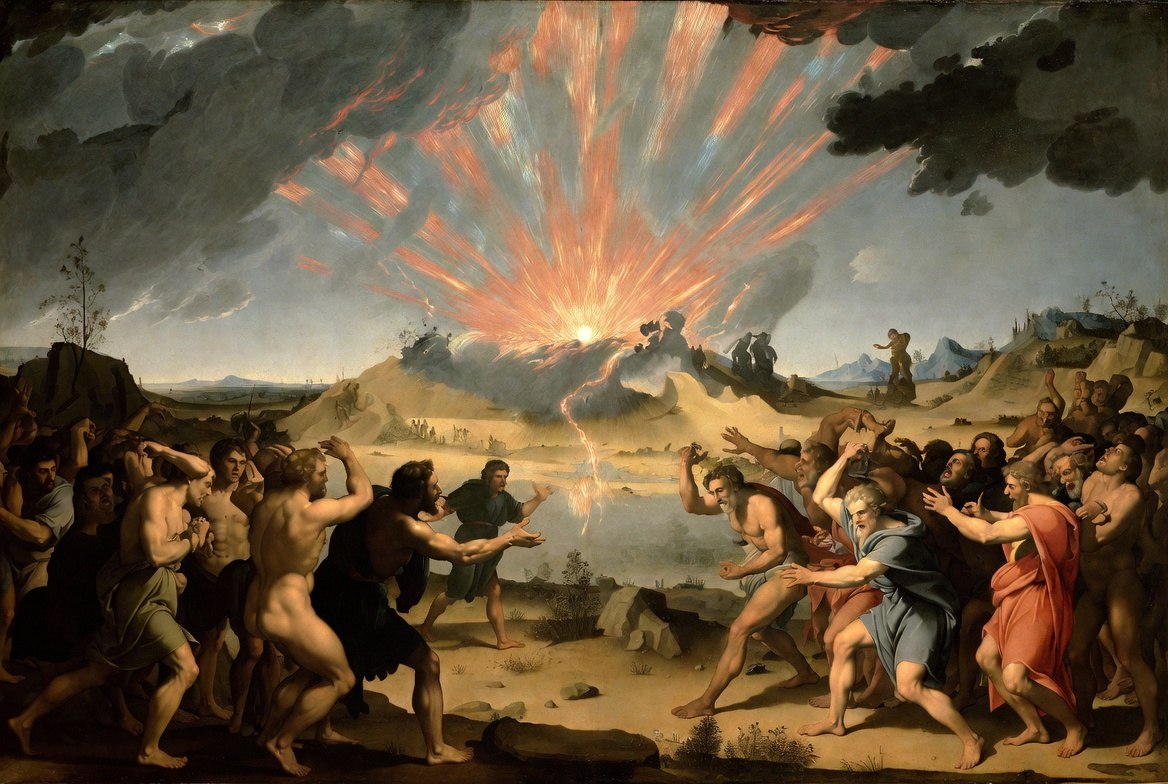
A theophany breaks over two crowds on opposite banks, the whole scene arrested in the same instant of turning.
Part I: Lexical Foundations in the Tanakh – Shuv and Nacham
The Old Testament (Tanakh) presents repentance through two primary verbal roots whose semantic ranges and theological freight must be distinguished yet held together. The dominant term is the verb שׁוּב (shuv), which occurs well over one thousand times across the Hebrew Scriptures. Its fundamental meaning is spatial and directional: to turn back, to return, to retrace one’s steps, to go back to a point of origin or to a previous state or relationship. The first occurrence appears in Genesis 3:19, where the Lord declares to the fallen Adam that he shall “return [shuv] to the ground,” underscoring that sin has disrupted the original creational trajectory and that return is always movement back toward the source from which one has departed.
In covenantal contexts shuv consistently denotes a concrete reversal of direction. When the prophets summon Israel, they employ shuv to command a turning away from evil ways and a simultaneous turning toward the Lord and His Torah. Deuteronomy 30:2–3, 9–10 provides the classic formulation: if the people “return [shuv] to the LORD your God” with all their heart and soul, obeying His voice according to all that is written in the book of the law, then the Lord will restore their fortunes. The motion is twofold and inseparable: cessation of the path of rebellion and active return to the covenant Lord. Isaiah 55:7 crystallizes the same demand: “let the wicked forsake his way, and the unrighteous man his thoughts; let him return [shuv] to the LORD, that he may have compassion on him.” Here the intellectual and volitional dimensions appear alongside the behavioral; thoughts as well as ways must be abandoned.
The prophets intensify the call. Jeremiah repeatedly employs shuv both as command and as diagnosis of failure. In Jeremiah 3:12–14, 22 the Lord pleads, “Return [shuv], faithless Israel… Return, O faithless children.” Yet in Jeremiah 13:23 the prophet articulates the human impossibility: “Can the Ethiopian change his skin or the leopard his spots? Then also you can do good who are accustomed to do evil.” The will, once habituated to evil, lacks the intrinsic capacity for self-correction. This sets the stage for the divine initiative that will be unveiled in the New Covenant promise of Jeremiah 31:18, where Ephraim cries, “Turn me [hashiveni], and I will be turned [ve-ashuva].” True shuv requires an external, divine catalyst; the broken compass cannot reorient itself.
The noun derived from the same root, תְּשׁוּבָה (teshuvah), carries the developed sense of “repentance” as return. It appears in contexts of national and individual restoration, always implying concrete behavioral and relational realignment rather than mere interior sentiment. Shuv therefore reveals that sin is fundamentally a wandering away from the covenant path and that repentance is the literal retracing of steps back to the Lord who alone can receive and restore.
The second major Hebrew term is נָחַם (nacham), which occurs approximately 108 times and carries a semantic range encompassing to comfort, to be sorry, to relent, to change one’s mind or course of action, and to breathe deeply in sorrow or relief. Its etymology suggests a physical, somatic dimension—a deep sighing or groaning that accompanies a shift in disposition or decree. When used of human beings, nacham frequently denotes the emotional and volitional aftermath of sin or calamity (e.g., Genesis 6:6 in the divine perspective on human wickedness; Genesis 24:67; 27:42). When predicated of God, it underscores the relational, non-static character of the divine dealings with humanity. Exodus 32:14 records that “the LORD relented [nacham] from the disaster that he had spoken of bringing on his people” in response to Moses’ intercession. Jonah 3:9–10 provides the clearest linkage of nacham with human turning: the people of Nineveh “turned [shuv] from their evil way,” and God “relented [nacham] of the disaster that he had said he would do to them.”
Jeremiah 18:7–8 explicitly joins the two verbs: if the nation against which the Lord has spoken “turns [shuv] from its evil, I will relent [nacham] concerning the calamity I planned.” Nacham thus supplies the affective and decisional register that shuv alone might appear to lack; it is the deep, often painful breathing out of the old orientation that makes space for the new divine purpose. Far from portraying God as capricious, the divine use of nacham reveals a covenant Lord who responds dynamically to the genuine turning of His creatures, all while remaining sovereign and faithful to His ultimate purposes.
Together, shuv and nacham establish that Old Testament repentance is never reducible to feeling sorry, performing ritual, or making isolated moral resolutions. It is a holistic return—spatial, relational, behavioral, emotional, and decisional—back to the living God along the path of His revealed will. Anything less leaves the wanderer still facing the wrong direction.
Part II: The New Testament Fulfillment – Metanoia and Epistrophe
The New Testament does not abandon the Old Testament pattern but fulfills and deepens it through the Greek terms μετάνοια (metanoia) and its cognate verb μετανοέω (metanoeō), together with ἐπιστροφή (epistrophē) and its verb ἐπιστρέφω (epistrephō). Metanoia is a compound of meta (indicating change, transformation, or movement beyond) and nous (mind, intellect, perception, or the faculty by which one apprehends reality). Its classical and Septuagintal background already points toward a change of mind or after-thought that issues in altered conduct, yet the New Testament invests the term with eschatological and christological depth.
In the Gospels, metanoeō stands at the threshold of the kingdom proclamation. John the Baptist’s summons in Matthew 3:2 and Mark 1:4, echoed by Jesus in Matthew 4:17 and Mark 1:15, is “Repent [metanoeite], for the kingdom of heaven is at hand.” The imperative is urgent and apocalyptic: the arrival of the King demands immediate reorientation of perception and life. Luke 13:3, 5 intensifies the warning: “unless you repent, you will all likewise perish.” Here metanoia is presented as the necessary condition for escaping eschatological judgment; it is not optional emotional coloring but the decisive turning that aligns one with the incoming reign of God.
The etymology is decisive. Metanoia is not primarily sorrow (though godly sorrow may accompany it, as in 2 Corinthians 7:9–10) but a structural transformation of the nous—the very mechanism by which one perceives, judges, and orients toward reality. It is a change of mind that entails a change of worldview, values, and direction. This is why the term can function in contexts of salvation as a virtual synonym for the reception of the gospel itself (cf. Acts 2:38; 3:19; 17:30; 20:21; 26:20). The mind that once suppressed the truth in unrighteousness (Romans 1:18) or was hostile to God (Romans 8:7) is renewed so that it can “discern what is the will of God” (Romans 12:2, using the related language of anakainōsis tou noos).
Epistrophē supplies the complementary outward and relational dimension. Derived from epi (toward) and strephō (to turn), it denotes conversion as an active turning toward God and away from idols or former ways. In the Septuagint it regularly renders shuv. In the New Testament it appears in Acts 15:3 (“the conversion of the Gentiles”) and is paired with metanoeō in the programmatic call of Acts 3:19: “Repent therefore, and turn back [epistrepsate], that your sins may be blotted out.” Epistrophē emphasizes the visible, relational establishment of a new allegiance; it is the fruit and confirmation of the inner metanoia. While metanoia focuses on the transformation of perception and disposition, epistrophē stresses the resulting movement into fellowship with the living God and His people.
Paul’s usage reveals the christological intensification. Although the noun metanoia appears less frequently in the Pauline corpus than in the Gospels and Acts, the reality permeates his theology. Romans 12:2 commands the renewal of the mind precisely because the unredeemed phronēma tēs sarkos (mind of the flesh) is death and hostility toward God. Galatians 2:20 and 2 Corinthians 5:17 articulate the participatory reality: the old self has been crucified with Christ; a new creation has come. Repentance for Paul is not reformation of the old nature but its displacement by union with the risen Lord. The mind of the flesh gives way to the mind of Christ (1 Corinthians 2:16).
Thus the New Testament does not replace shuv and nacham but translates and fulfills them in light of the Messiah’s person and work. Metanoia corresponds most closely to the cognitive and ontological dimensions, while epistrophē captures the relational and behavioral return. Together they demand and describe a transformation that the unaided human will cannot produce.
Part III: The Integrated Biblical Pattern – Anatomy and Flow
When the lexical data are synthesized, a coherent structural flow emerges across both Testaments. Genuine repentance begins with an internal realization and transformation of the nous (metanoia): the mind is renewed to perceive sin as the horror it is and God as the treasure He is. This cognitive shift is accompanied by the somatic and emotional release denoted by nacham—a deep, often painful sighing or groaning that acknowledges the gravity of sin and the justice of divine displeasure. The emotional component, however, is never an end in itself; it issues in the concrete, spatial, and covenantal reversal of shuv—a turning away from the path of rebellion and a return to the Lord and His ways. The entire movement becomes visible and relational in epistrophē, the conversion that establishes new allegiance and produces fruit in keeping with repentance (Matthew 3:8; Luke 3:8).
This sequence is never merely sequential in a mechanical sense; it is organic and Spirit-enabled. The human contribution is real yet derivative: the willingness to take the first microscopic step of turning opens the door for divine initiative that accomplishes what the creature cannot (Jeremiah 31:18; Ezekiel 36:26–27). Repentance is therefore both commanded as human responsibility and promised as divine gift. Any presentation that severs these elements either breeds presumption or despair.
Part IV: Prophetic and Cosmic Dimensions
The prophets refuse to confine repentance to the individual moral sphere. When the covenant is violated, creation itself suffers a form of reverse genesis, sliding back toward tohu va-bohu. Jeremiah 4:23–26 depicts the land returning to chaos because of human sin. Consequently, prophetic shuv is cosmic restoration. Jeremiah 31:18–34 reveals both the human incapacity (“Turn me, and I will be turned”) and the divine solution: the New Covenant in which the Lord writes His Torah on the heart, forgives iniquity, and remembers sin no more. The internal compass is rewired by sovereign grace.
Ezekiel develops the mechanics with surgical precision. Ezekiel 18:31–32 issues the seemingly impossible command: “Cast away from you all the transgressions that you have committed, and make yourselves a new heart and a new spirit! Why will you die, O house of Israel?” The answer arrives in Ezekiel 36:26–27: “I will give you a new heart, and a new spirit I will put within you. And I will remove the heart of stone from your flesh and give you a heart of flesh. And I will put my Spirit within you, and cause you to walk in my statutes.” Stone represents that which is static, impermeable, unresponsive to the Word and the wind of the Spirit. Flesh (basar) is living, permeable, capable of feeling, bleeding, absorbing, and moving. The Valley of Dry Bones (Ezekiel 37) dramatizes the outcome: sinews and flesh are restored, then breath (ruach) from the four winds—resurrection by divine ruach.
Prophetic repentance is therefore ontological resurrection: the removal of the calcified ego and the infusion of divine life. It is cosmic in scope because sin has cosmic consequences, and the restoration must reach the deepest structures of created reality.
Part V: Dispensational Progression – Preparatory and Participatory Metanoia
John the Baptist occupies the threshold. His metanoia is preparatory, ethical, and urgent. It demands “fruit in keeping with repentance” (Matthew 3:8; Luke 3:8–14): societal equity, cessation of extortion, renunciation of violence. It is water baptism—a cleansing that lays the axe to the root and brings the old self to the edge of its capacity. John explicitly acknowledges its limit: “I baptize you with water for repentance, but he who is coming after me… will baptize you with the Holy Spirit and fire” (Matthew 3:11). John prepares the way; he cannot impart the new nature.
Paul moves from preparation to participation. Repentance is now union with Christ in His death and resurrection. “I have been crucified with Christ. It is no longer I who live, but Christ who lives in me” (Galatians 2:20). “If anyone is in Christ, he is a new creation” (2 Corinthians 5:17). The old self is not improved; it is executed. The mind of the flesh is displaced by the mind of Christ. Repentance is the daily appropriation of this reality—“put to death therefore what is earthly in you” (Colossians 3:5; cf. Romans 8:13; Galatians 5:24). John brings the sinner to the threshold; Paul plunges the believer into the mystical reality of co-crucifixion and co-resurrection.
Part VI: The Paradigmatic Case – Psalm 51
Psalm 51 remains the most intimate and comprehensive anatomy of repentance in Scripture. After adultery and murder, David refuses the refuge of ritual. Verses 16–17 declare: “For you will not delight in sacrifice, or I would give it; you will not be pleased with a burnt offering. The sacrifices of God are a broken spirit; a broken and contrite heart, O God, you will not despise.” External performance can mask the absence of internal transformation; David offers only his shattered interior.
The language is relentlessly somatic. “Wash me thoroughly” (kabbeseni) evokes the violent treading and beating of garments by a launderer. “Cleanse me” (teteharini) employs the vocabulary of leprosy purification. Verse 8 pleads, “Let me hear joy and gladness; let the bones that you have broken rejoice.” True repentance feels like structural breaking; the very framework of the persona must be shattered so that it may be reset by the divine Physician.
The theological climax occurs in verse 10: “Create in me a clean heart, O God, and renew a right spirit within me.” The verb בָּרָא (bara) is the same term used in Genesis 1:1 for ex nihilo creation—used exclusively of divine activity. David does not ask God to repair or remodel the old heart; he recognizes that it is a moral wasteland beyond salvage. He requires a new Genesis spoken into the void of his failure. Immediately he prays for “a right/steadfast spirit” (ruach nachon)—stable, locked-in, no longer volatile. Psalm 51 thus demonstrates that genuine shuv is surrender to an agonizing process of internal collapse so that God may perform a sovereign act of new creation.
Part VII: What Repentance Is Not
Scripture is equally clear about counterfeits. Repentance is not mere emotional agitation or worldly sorrow that produces death (2 Corinthians 7:10). It is not ritual performance or sacramental observance detached from heart transformation. It is not moral self-improvement or the resolution to “do better next time.” It is not the temporary cessation of particular sins while the orientation of the heart remains unchanged. Esau’s tears (Hebrews 12:17) and Judas’s regret (Matthew 27:3–5; metamelomai) illustrate remorse without return. The warnings of Hebrews 6:4–6 and 10:26–31 stand as solemn fences: those who have tasted the heavenly gift and then fall away cannot be restored again to repentance, for they are crucifying the Son of God afresh. Matthew 7:21–23 pronounces judgment on those who prophesy, cast out demons, and perform mighty works yet never knew the Lord—outward activity without inward transformation.
Any presentation of repentance that minimizes the necessity of mind renewal, heart of flesh in place of stone, or participatory death with Christ leaves sinners with a false assurance that is more dangerous than open rebellion. The unregenerate who hear the biblical demand and refuse it stand without excuse; the called-out assembly that substitutes emotionalism or ritual for the real article deceives its own members.
Part VIII: Christological and Pneumatological Center
At the center stands the Messiah. Repentance is possible only because He has borne the curse and risen in victory. Union with Him in death and resurrection (Romans 6:1–11) is the mechanism by which “death to the flesh” becomes effective. “Those who belong to Christ Jesus have crucified the flesh with its passions and desires” (Galatians 5:24). “If by the Spirit you put to death the deeds of the body, you will live” (Romans 8:13). The Spirit who raised Jesus from the dead dwells in believers and empowers the daily mortification that is the ongoing expression of repentance. The “emergent life of the Spirit” is nothing less than the new creation already inaugurated, the firstfruits of the age to come.
Part IX: Implications for the Called-Out Assembly
Within the ekklesia—the called-out assembly that is the body of Christ—repentance remains the continual posture of the saints. The letters to the seven assemblies in Revelation 2–3 repeatedly summon the congregations to repent: of lovelessness, compromise, false teaching, spiritual deadness, and lukewarmness. Corporate repentance is as necessary as individual. Daily mortification, confession, and return characterize the normal Christian life. The assembly that loses the note of repentance loses its saltiness and its light.
Eschatologically, repentance prepares the called-out assembly for the day of the Lord. Second Peter 3:9 declares that the Lord is “not wishing that any should perish, but that all should reach repentance.” The Sun of Righteousness (Malachi 4:2) will arise with healing for those who fear His name and with consuming fire for the arrogant. The same event that is terror to the unrepentant is the gateway to everlasting joy for those who have returned.
Conclusion: The Solemn Call
Repentance is not a feeling, a ritual, a moral upgrade, or a one-time decision. It is the radical, ongoing reorientation of the whole person—mind transformed by metanoia, heart softened from stone to flesh, will returning by shuv, life bearing the visible fruit of epistrophē—made possible only by union with the crucified and risen Christ and empowered by the indwelling Spirit. It is death to the flesh and emergent life of the Spirit. It is commanded of all, yet impossible apart from divine initiative. It is the narrow gate through which alone one enters the kingdom, the narrow path along which the saints walk, and the posture that marks the called-out assembly until the Lord returns.
To those who belong to the body of Christ, this examination is intended to strengthen resolve, clarify the nature of the daily return, and fuel joyful obedience. To those outside, the biblical witness stands as a clear and solemn testimony: the demand is total, the impossibility apart from grace is total, and the provision in Christ is total. There is therefore no excuse for continued wandering. The call remains urgent and unchanged: Repent, for the kingdom of heaven is at hand. Turn, and live.