The Shape of the Unbroken Soul: The Experiential Categories, Shifting Contexts, and Eternal Reality of Ceaseless Prayer
Source: raw/The Eternal Reality of Ceaseless Prayer.pdf
Introduction: Beyond the Checklist of the Soul
To reduce prayer to a scheduled event on a calendar is to misunderstand the very nature of the New Covenant. When prayer is treated as a discrete task with a defined beginning and ending, it is stripped of its mystical and ontological reality. It diminishes the profound truth that, for the believer, life does not merely contain prayer; rather, the redeemed life is the location of an ongoing, cosmic conversation. Prayer is not a transactional performance managed by an alarm clock; it is a permanent state of consciousness, an unbroken orientation of the soul that persists through conscious work, casual conversation, and even the deepest hours of physical sleep.
When the Apostle Paul admonishes the church at Thessalonica to “pray without ceasing,” he is not delivering an impossible behavioral burden, but describing a baseline psychological reality. To understand this continuous state, we must look past the superficial “elements” of prayer (such as the standard formulas of Adoration, Confession, Thanksgiving, and Supplication) and examine the deeper experiential styles, psychological states, and relational dynamics that characterize human communion with the divine. By exploring these diverse categories, tracing the massive contextual shifts from the Old to the New Testament, parsing the original languages of Scripture, and anchoring our understanding in the theological bedrock of Romans Chapter 8, we discover a blueprint for a life lived in uninterrupted fellowship with Jesus Christ.
Visual Companion
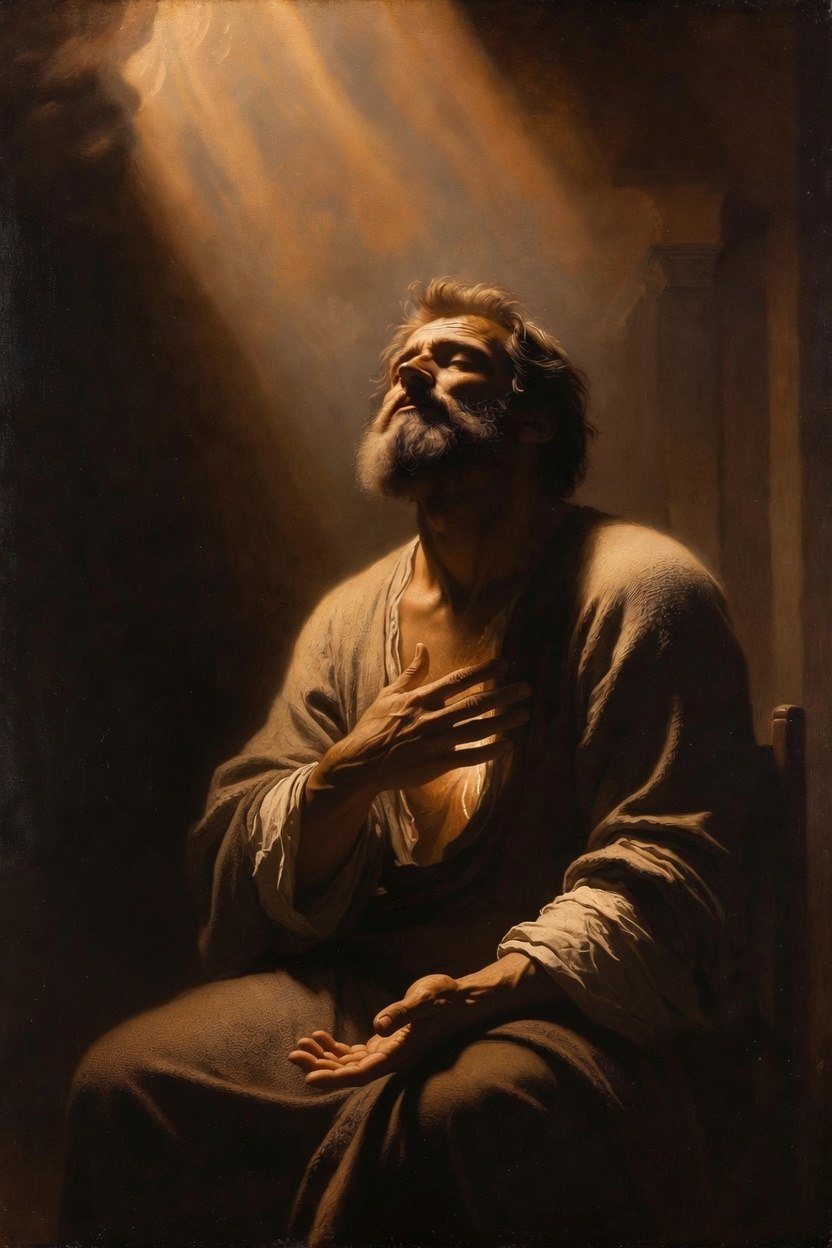
Prayer as a continuous posture of the soul, held in the light of divine presence rather than confined to a scheduled task.
Part I: The Spectrum of Human Experience—Nine Typologies of Prayer
Throughout the biblical narrative, human beings do not approach God in a monolithic fashion. The Holy Spirit utilizes the full range of human emotion, psychology, and posture. Theologians and sociologists of religion have identified distinct experiential categories of prayer, each possessing its own unique relational dynamic and scriptural witness.
1. Contemplative Prayer (The Posture of Silence)
Contemplative prayer is characterized by silent, non-verbal immersion in the divine presence. It is the deliberate quieting of human intellectual faculty to rest in loving awareness of God. In a world dominated by noise, contemplation removes words entirely, recognizing that language can sometimes act as a barrier to ultimate intimacy.
- Scriptural Witness: In Psalm 131:2, David writes, “But I have calmed and quieted my soul, like a weaned child with its mother; like a weaned child is my soul within me.” The image is not of a child crying out for milk (petition), but a child completely satisfied, resting silently against the mother’s chest.
- Contextual Echoes: This style is beautifully illustrated in 1 Kings 19:12, where the prophet Elijah waits for God in a cave. God does not manifest in the tearing wind, the earthquake, or the fire, but in a “still small voice”—a phrase better translated from the Hebrew demamah daqqah as “a sound of sheer silence.” It is also seen in Luke 5:16, where Jesus frequently “withdrew to desolate places and prayed,” seeking the silent canopy of the wilderness to rest in communion with the Father.
2. Dialogical Prayer (The Posture of Conversation)
Dialogical prayer is an unscripted, raw, two-way conversation. It treats God not as a distant monarch to whom a petition must be formalistically submitted, but as an intimate confidant with whom one can reason, question, and barter.
- Scriptural Witness: The quintessential dialogical text is found in Genesis 18:23–33, where Abraham stands before the Lord and explicitly barters over the impending judgment of Sodom: “Will you sweep away the righteous with the wicked? What if there are fifty righteous… Far be it from you to do such a thing!” God engages in this back-and-forth, answering Abraham’s questions in real-time.
- Contextual Echoes: This conversational dynamic is verified in Exodus 33:11, which notes that “the Lord used to speak to Moses face to face, as a man speaks to his friend.” Similarly, the prophet Habakkuk sets up a dialogical framework in Habakkuk 2:1, declaring, “I will take my stand at my watchpost… and look out to see what he will say to me, and what I will answer concerning my complaint.”
3. Ecstatic Prayer (The Posture of Transcendence)
Ecstatic prayer involves an emotionally uninhibited, non-rational, or trance-like spiritual state where the human psyche is overwhelmed by divine euphoria. In this category, the constraints of ordinary language and decorum dissolve.
- Scriptural Witness: In the New Testament, this manifests clearly in 1 Corinthians 14:14, where Paul writes, “For if I pray in a tongue, my spirit prays, but my mind is unfruitful.” This represents a bypass of the analytical mind, allowing the spirit to communicate via transcendent, charismatically generated language.
- Contextual Echoes: In the Old Testament, this ecstatic state is vividly captured in 2 Samuel 6:14–22, when King David dances wildly before the Ark of the Covenant, completely unconcerned with royal dignity, responding to his critics that he will make himself “even more contemptible than this” in his celebration of God. It appears again on the Day of Pentecost in Acts 2:4–13, where the effusion of the Holy Spirit causes the believers to speak spontaneously in other tongues, leading onlookers to mistakenly assume they are “filled with new wine.”
4. Intercessory Prayer (The Posture of Mediation)
Intercession is altruistic petition. It occurs when a pray-er steps out of their own personal needs and stands as a spiritual mediator, pleading on behalf of another individual, city, or nation.
- Scriptural Witness: In Exodus 32:11–14, after Israel commits spiritual adultery with the golden calf, Moses steps into the breach to intercept divine wrath: “Turn from your fierce wrath; relent and do not bring disaster on your people.” Moses appeals to God’s covenantal reputation, and the text records that the Lord relented.
- Contextual Echoes: This is seen in Daniel 9, where Daniel fasts, puts on sackcloth, and confesses the sins of his nation as if they were his own, begging for the restoration of Jerusalem. In the New Testament, Jesus models this specific category for Peter in Luke 22:32: “But I have prayed for you that your faith may not fail.”
5. Ritualistic / Liturgical Prayer (The Posture of Tradition)
Ritualistic or liturgical prayer relies on structured, communal, and historically preserved texts. Far from being inherently vain repetitions, proper liturgical prayer aligns the individual’s voice with the historical heritage and corporate unity of the global church.
- Scriptural Witness: When the disciples asked Jesus how to pray, He did not tell them to wait for a spontaneous feeling; instead, He gave them a liturgical script. In Matthew 6:9–13, He commands, “Pray then like this: Our Father in heaven, hallowed be your name…”
- Contextual Echoes: This structured approach is rooted in the Old Testament, such as the fixed Aaronic Blessing found in Numbers 6:24–26, which the priests were commanded to recite verbatim over Israel: “The Lord bless you and keep you…” In the early church, this was maintained through the corporate singing and reciting of the Psalms, as encouraged in Colossians 3:16: “singing psalms and hymns and spiritual songs, with thankfulness in your hearts to God.”
6. Imprecatory Prayer (The Posture of Outrage)
Imprecatory prayer is the holy channeling of raw anger, grief, and indignation into the hands of God. Rather than taking personal vengeance, the pray-er cries out for divine justice to smash oppressive systems and defeat spiritual or physical enemies.
- Scriptural Witness: The most shocking and honest example of this is found in Psalm 137:8–9: “O daughter of Babylon, doomed to be destroyed… Blessed shall he be who takes your little ones and dashes them against the rock!” This is the unfiltered cry of an exiled victim of Babylonian war crimes handing their psychological trauma over to God.
- Contextual Echoes: David utilizes this category frequently, such as in Psalm 109:6–10, where he prays concerning his betrayer: “Let his days be few; may another take his office! May his children be fatherless and his wife a widow!” In the New Testament, this voice of outrage continues in Revelation 6:10, where the martyred saints under the heavenly altar cry out with a loud voice: “O Sovereign Lord, holy and true, how long before you will judge and avenge our blood on those who dwell on the earth?”
7. Lament / Agonistic Prayer (The Posture of Crisis)
Lament is the prayer of the dark night of the soul. It is characterized by wrestling, deep psychological distress, and heavy weeping. It does not hide its pain behind theological platitudes; it brings its raw grief directly into the presence of God.
- Scriptural Witness: In the Garden of Gethsemane, Jesus models the absolute pinnacle of agonistic prayer in Matthew 26:38–39: “My soul is very sorrowful, even to death… And going a little farther he fell on his face and prayed, saying, ‘My Father, if it be possible, let this cup pass from me; nevertheless, not as I will, but as you will.’” Luke 22:44 adds that “being in agony he prayed more earnestly; and his sweat became like great drops of blood falling down to the ground.”
- Contextual Echoes: This style is witnessed in 1 Samuel 1:10, where Hannah, desperate for a child, prays to the Lord “in bitterness of soul and wept bitterly,” moving her lips so silently and frantically that the High Priest Eli accuses her of public drunkenness. It is anchored visually on the cross when Christ cries out the opening line of Psalm 22 in Mark 15:34: “Eloi, Eloi, lema sabachthani?” which means, “My God, my God, why have you forsaken me?”
8. Prophetic / Declarative Prayer (The Posture of Authority)
Prophetic or declarative prayer does not speak to God about a problem; rather, it stands in divine authority and speaks for God to the problem. It commands a shift in physical or spiritual reality based on a direct word or burden received from the Almighty.
- Scriptural Witness: In James 5:17–18, the writer highlights this authoritative posture: “Elijah was a man with a nature like ours, and he prayed fervently that it might not rain, and for three years and six months it did not rain on the earth. Then he prayed again, and heaven gave rain, and the earth bore its fruit.” Elijah’s prayers were declarations of judgment and restoration.
- Contextual Echoes: This authoritative category is seen when Joshua speaks directly to celestial bodies in Joshua 10:12: “Sun, stand still at Gibeon, and moon, in the Valley of Aijalon.” In the New Testament, it is demonstrated by Peter in Acts 9:40 when he turns to the corpse of Tabitha and issues a direct command: “Tabitha, arise.”
9. Prayer of Consecration / Relinquishment (The Posture of Surrender)
The prayer of relinquishment is the voluntary surrender of personal agency, human ambition, and control over one’s destiny into the sovereign hands of God. It is the transition from wanting our will to be done to desiring only the divine purpose, regardless of the personal cost.
- Scriptural Witness: Mary, the mother of Jesus, offers the definitive prayer of consecration in Luke 1:38 when her life is radically disrupted by the angelic announcement: “Behold, I am the servant of the Lord; let it be to me according to your word.”
- Contextual Echoes: We see this at the end of Christ’s life in Luke 23:46 when He cries out from the cross, “Father, into your hands I commit my spirit!” It is executed communally in Acts 13:2–3, where the leaders of the church at Antioch are fasting and worshiping, and upon hearing the Holy Spirit, lay hands on Paul and Barnabas, relinquishing them to a dangerous missionary journey.
Part II: The Contextual Metamorphosis—Same Heart, New Horizon
A common misconception is that the nature of prayer itself underwent a dramatic evolution between the Old and New Testaments—as if Old Testament saints prayed poorly and New Testament saints prayed correctly. In reality, human heart postures have not changed. The weeping of Hannah is psychologically identical to the weeping of Jesus in Gethsemane; the ecstatic dancing of David matches the charismatic joy of Pentecost. What changed was not the prayer, but the context in which the prayer occurred.
The advent of Jesus Christ and the outpouring of the Holy Spirit completely transformed the spiritual, geographic, and relational landscape. This contextual shift can be parsed through three distinct categories.
OLD TESTAMENT CONTEXT NEW TESTAMENT CONTEXT ┌─────────────────────────────────┐ ┌─────────────────────────────────┐
│ SPATIAL BOUNDARY │ │ SPATIAL EXPLOSION │
│ Localized Presence: Temple, │───>│ The Believer’s Body is the │
│ Tabernacle, facing Jerusalem │ │ Temple; Omnipresent Reality │
└─────────────────────────────────┘ └─────────────────────────────────┘
┌─────────────────────────────────┐ ┌─────────────────────────────────┐
│ MEDIATORIAL BOUNDARY │ │ DIRECT ACCESS │
│ Access via Human Priests, │───>│ The Veil is Torn; Direct Entry │
│ Prophets, and Leaders │ │ through Jesus the High Priest │
└─────────────────────────────────┘ └─────────────────────────────────┘
┌─────────────────────────────────┐ ┌─────────────────────────────────┐
│ COVENANTAL BOUNDARY │ │ GLOBAL INDWELLING │
│ National Survival, Land, │───>│ Internal Transformation, │
│ Agricultural Blessings │ │ Global, Spiritual Kingdom │
└─────────────────────────────────┘ └─────────────────────────────────┘
1. The Spatial Context: From Localized Geography to Omnipresent Reality
In the Old Covenant, the presence of God was understood to be structurally and geographically localized. While God was omnipotent, His manifest presence dwelt between the cherubim in the Holy of Holies—first in the portable Tabernacle and later in the stone Temple built by Solomon in Jerusalem. Consequently, prayer was tied to sacred space.
When Solomon dedicated the temple in 1 Kings 8:30, he prayed: “And listen to the plea of your servant and of your people Israel, when they pray toward this place. And listen in heaven your dwelling place…” When Daniel was exiled in Babylon, Daniel 6:10 records that he went to his upper room, “where he had windows open toward Jerusalem,” and knelt three times a day to pray. Geography mattered.
In the New Covenant, this spatial restriction is dissolved. In John 4:21–23, Jesus informs the Samaritan woman: “the hour is coming when neither on this mountain nor in Jerusalem will you worship the Father… the true worshipers will worship the Father in spirit and truth.” Through Christ, the physical building is made obsolete because the human body is reframed as the sacred sanctuary. Paul writes in 1 Corinthians 6:19: “Or do you not know that your body is a temple of the Holy Spirit within you…?” The context of prayer shifts from a journey to a physical destination to a continuous awareness of an interior sanctuary.
2. The Mediatorial Context: From Human Intermediaries to Direct Access
Under the Old Covenant, the average human being could not walk casually into the presence of God. Access was highly regulated and restricted to human mediators—primarily the Levitical priesthood. Once a year, on the Day of Atonement, only the High Priest could pass through the thick veil into the Holy of Holies, carrying the blood of animals to make intercession for national sins (Leviticus 16). If an ordinary Israelite needed to consult God or seek forgiveness, they brought a sacrifice to a priest or sought out a prophet who could “stand in the gap” (Ezekiel 22:30).
The New Testament context shifts this relational dynamic through the tearing of the temple veil at the moment of Christ’s crucifixion (Matthew 27:51). This physical tearing signified that human mediation was finished. The writer of the Epistle to the Hebrews explains that we now have an eternal High Priest, Jesus Christ, who has passed through the heavens. Therefore, the context is now one of unhindered, direct entry: “Let us then with confidence draw near to the throne of grace, that we may receive mercy and find grace to help in time of need” (Hebrews 4:16). You no longer need to book an appointment with a spiritual middleman; the channel is direct, immediate, and permanently open.
3. The Covenantal Context: From National Prosperity to Spiritual Transformation
Old Testament prayer was heavily contextualized by the parameters of the Mosaic Covenant. In texts like Deuteronomy 28, God promised physical protection from geopolitical enemies, agricultural abundance, rain in its season, and literal land in exchange for covenantal faithfulness. Thus, when kings like Jehoshaphat prayed (2 Chronicles 20), they were pleading for military salvation and national survival against physical empires like Moab and Ammon.
In the New Covenant, the context transitions from a physical, national kingdom to an internal, spiritual, global reality. Our warfare is no longer against flesh and blood, but against “spiritual forces of evil in the heavenly places” (Ephesians 6:12). The material promises of the land are transformed into the spiritual fruit of the Spirit—love, joy, peace, and patience (Galatians 5:22-23). Prayers of petition and lament are no longer preoccupied with the destruction of Babylonian soldiers, but with the tearing down of internal strongholds, the sanctification of the heart, and the global expansion of the Gospel.
Part III: Exposing Misalignments—The Anatomy of James’s Warning
Understanding these contextual shifts allows us to interpret James 4:2–3 with clarity. James issues a stern caution regarding proper versus improper prayer:
“You desire and do not have, so you murder. You covet and cannot obtain, so you fight and quarrel. You do not have, because you do not ask. You ask and do not receive, because you ask wrongly, to spend it on your passions.”
When James states that believers “ask wrongly”—using the Greek word κακῶς (kakōs), meaning wickedly, improperly, or with diseased motives—he is exposing a structural misalignment between the mechanism of prayer and the covenantal context of the new heart.
Improper prayer occurs when an individual utilizes the vocabulary of petition but strips it of the spirit of consecration and relinquishment. It treats the sovereign Creator as a celestial vending machine designed to fulfill the base cravings of the ego. The Greek word James uses for “passions” or “pleasures” is ἡδοναῖς (hēdonais), from which we derive the word hedonism.
To pray kakōs is to take a divine instrument designed for communion and weaponize it for self-aggrandizement. It is asking God to bless an idol.
Proper prayer, conversely, is not defined by linguistic perfection or mechanical formula, but by relational alignment. Proper prayer is inherently transformational; it does not seek to bend God’s will to human desire, but bends human desire to God’s will. It aligns perfectly with the Gethsemane posture: “not my will, but yours, be done.”
Part IV: The Mechanics of the Unbroken Stream—Adialeiptōs and the Subconscious Reins
If prayer is restricted to the vocal execution of liturgies or the verbal expression of lists, Paul’s command in 1 Thessalonians 5:17 to “pray without ceasing” stands as an impossible, legalistic standard. A human being must sleep, engage in complex cognitive labor, and converse with other people. How then can one pray every single microsecond?
The Siege of the Soul: Unpacking Adialeiptōs
The resolution lies in the specific Greek adverb Paul chooses: αδιαλειπτως (adialeiptōs). In classical Greek literature, this word did not mean a continuous, uninterrupted physical stream, such as a waterfall that never stops flowing. Rather, it was utilized in two distinct cultural contexts:
- Medical Terminology: Ancient physicians used adialeiptōs to describe a persistent, hacking cough or an intermittent fever. The patient is not coughing every single second of the day, but they are defined by a chronic condition. The cough returns relentlessly because the underlying physical state of the body has been altered.
- Military Terminology: It was used to describe a relentless military siege. A besieging army does not fire flaming arrows or swing battering rams every consecutive second; soldiers must eat, rest, and strategize. However, the army never drops its weapons, never breaks its perimeter, and never abandons the field. The city remains under a permanent state of siege.
By using adialeiptōs, Paul is instructing the church to develop a permanent, chronic state of spiritual awareness. It is a baseline state of consciousness where the communication channel is always open, the soul’s radar is constantly tuned to the divine frequency, and thoughts naturally dissolve back into communion the moment cognitive tasks are completed. It is a posture of perpetual availability to the Holy Spirit.
The Prayer of the Night: The Hebrew Kilyah
This continuous state of prayer is not limited to our waking hours. It bypasses our conscious mind and extends into our subconscious processing. King David records this profound psychological reality in Psalm 16:7:
“I will praise the Lord, who counsels me; even at night my heart instructs me.”
In the original Hebrew, the word translated as “heart” or “mind” is כִּלְיוֹתָי (kilyōtāy), which literally means my kidneys or reins. In ancient Near Eastern psychology, the kidneys were viewed as the seat of the deepest, subconscious emotions, secret desires, and involuntary impulses—the absolute core of human interiority below the surface of conscious thought.
CONSCIOUS MIND (Daytime) SUBCONSCIOUS REINS / KILYAH (Nighttime)
┌───────────────────────────────┐ ┌─────────────────────────────────────┐
│ • Verbal Expressions │ │ • Involuntary Spiritual Deep │
│ • Cognitive Tasks │────>│ • Subconscious Processing │
│ • Active Discernment │ │ • Unbroken Nighttime Instruction │
└───────────────────────────────┘ └─────────────────────────────────────┘
David is asserting that when his eyes close and his conscious mind slips into sleep, his kilyōtāy—his subconscious depths—remain actively engaged with and instructed by God. The spiritual anchor remains dropped in the divine ocean while the physical body recharges. Sleep is transformed from a spiritual vacuum into an active movement of contemplative prayer.
Part V: The Trinitarian Crucible—Romans 8 as the Living Environment of Prayer
The absolute theological blueprint for this 24/7, unscheduled prayer environment is found in the architectural masterpiece of the New Testament: Romans Chapter 8. Here, Paul moves past human effort and demonstrates that ceaseless prayer is a Trinitarian operation. The believer does not generate ceaseless prayer through sheer willpower; rather, the believer is swept up into an ongoing, eternal conversation already occurring within the Godhead.
Paul builds this reality through three structural descriptions of the Spirit’s operation.
1. The Familial Instinct: The Krazomen Cry (Verses 14–15)
“For all who are led by the Spirit of God are sons of God. For you did not receive the spirit of slavery to fall back into fear, but you have received the Spirit of adoption as sons, by whom we cry, ‘Abba! Father!’”
When Paul describes the believer crying out “Abba! Father!”, he employs the Greek verb κράζομεν (krazomen). This is an onomatopoetic word that denotes a raw, unpolished, instinctual scream or exclamation. It is the cry of a raven, or the non-calculated shriek of a terrified child running through a house looking for their parent.
This removes prayer from the realm of formal scheduling. A child does not set an appointment to interact with their parents at 6:00 AM and 8:00 PM; the child simply exists within the home, and when a crisis or joy occurs, an immediate, unscripted krazomen cry bursts from their lungs. The indwelling Spirit creates an immediate, permanent familial context where access is an atmospheric reality, not a performance checklist.
2. The Wordless Deep: Stenagmois Alalētois (Verses 26–27)
Paul then addresses the moments when human intellect hits an absolute wall—when trauma, exhaustion, or cognitive distraction leaves us with empty vocabulary:
“Likewise the Spirit helps us in our weakness. For we do not know what to pray for as we ought, but the Spirit himself intercedes for us with groanings too deep for words.”
- The Weight Share: The Greek word for “helps” is the massive compound verb συναντιλαμβάνεται (synantilambanetai). It combines syn (together with), anti (against), and lambano (to take hold of). It conjures the image of a person attempting to lift a massive, crushing log alone; suddenly, a strong companion steps opposite them, grabs the other end of the timber, and shares the crushing weight. The Holy Spirit steps into our intellectual and physical exhaustion to carry the burden of our prayerlessness.
- The Inarticulate Groan: When our conscious words fail, the Spirit initiates a profound internal intercession described as στεναγμοῖς ἀλαλήτοις (stenagmois alalētois)—groanings that are unutterable, wordless, and incapable of being articulated in human speech.
This is the definitive proof of ceaseless prayer outside a schedule. While you are working, writing, or sleeping, the Holy Spirit is utilizing your inner life as the canvas for an unspoken, uninterrupted, and perfectly aligned intercessory dialogue with the Father. Your life is the temple where the Spirit’s continuous loop of intercession never stops firing.
THE INDWELLING HOLY SPIRIT THE ASCENDED CHRIST JESUS ┌───────────────────────────────────────┐ ┌───────────────────────────────┐
│ Interceding WITHIN the Believer │ │ Interceding FOR the Believer │
│ via “Groanings Too Deep for Words” │ │ at the Right Hand of the │
│ (Romans 8:26-27) │ │ Father (Romans 8:34) │
└───────────────────────────────────────┘ └───────────────────────────────┘
╲ ╱
▼ ▼
┌────────────────────────────┐
│ THE BELIEVER’S SOUL │
│ Sustained in an Eternal, │
│ Continuous Crosscurrent │
└────────────────────────────┘
3. The Cosmic Crosscurrent: The Heavenly Intercession (Verse 34)
Paul completes the Trinitarian picture by lifting our eyes from our interior life up into the heavens:
“Who is to condemn? Christ Jesus is the one who died—more than that, who was raised—who is at the right hand of God, who indeed is interceding for us.”
The believer is caught in a beautiful cosmic crosscurrent of prayer. When you look inside yourself, the Holy Spirit is interceding within you via wordless groans (Verse 26). When you look above yourself, the Lord Jesus Christ is interceding for you at the right hand of majesty (Verse 34). You are completely surrounded. Prayer is not a bridge you must build through disciplined scheduling; it is an eternal, living river flowing between the Father, Son, and Holy Spirit, and you have been plunged directly into the middle of its current.
Conclusion: Hope, Admonition, and the Eternal Fellowship
To understand prayer through this exhaustive, scriptural framework is to be delivered from the condemnation of the checklist. There is immense hope in this reality: you are freed from the legalistic anxiety that whispers you have not prayed enough today. If you are in Christ, your very life—your working, your breathing, your laughing, and your sleeping—is integrated into the continuous loop of divine fellowship. When your conscious vocabulary fails, the Spirit’s synantilambanetai mechanism ensures that your weakness is covered by stenagmois alalētois. When you sleep, your kilyah instructs you in the night. The pressure is off your performance; the weight is carried by the Trinitarian reality.
Yet, this hope carries a sharp, urgent admonition. To know that the channel is permanently open is an invitation to stop treating your thoughts as private property. The admonition is to align your conscious mind with this background reality. Do not compartmentalize your life, acting as though Christ is present only during brief, self-inflicted spiritual moments while leaving Him locked out of your daily labor, your entertainment, or your trials. Guard your motives fiercely; remember the warning of James, and do not degrade this majestic, open highway of communion into a diseased mechanism for selfish passions (kakōs).
The veil is torn. The True Temple is not a building in Jerusalem, but the space inside your ribs. The Spirit is groaning, Christ is pleading, and the Father is listening. Maintain the siege of the soul (adialeiptōs). Step into the current, open your heart to the constant presence of the Indwelling Guide, and let every waking breath and nocturnal rest become a continuous, vibrant amen to the presence of Jesus Christ.