The Ungraspable Light: Moses, Aquinas, Idolatry, and the Eclipse of Representation
Source: raw/The Ungraspable Light.pdf
Introduction: The Failure of the Net
“I can do no more. Such things have been revealed to me that all I have written seems as so much straw.” With this definitive surrender on December 6, 1273, St. Thomas Aquinas laid down his pen, leaving the Summa Theologiae forever unfinished. For decades, Thomas had operated as Western Christendom’s premier intellectual craftsman, building an unparalleled cathedral of words, logic, and definitions. Yet, at the apex of his career, an encounter with the unmediated divine presence reduced his monumental lifework to ash. To understand this sudden collapse of human expression is to enter into the cosmic architecture outlined at the dawn of the Johannine Gospel: “The light shines in the darkness, and the darkness has not overcome it” (John 1:5).
At the heart of this cosmic declaration lies a profound linguistic double-meaning that exposes the raw tension between human representation and divine reality. When we trace the mechanics of Thomas’s silence through the biblical anatomy of sight, we uncover an eternal, violent contrast between the Beatific Vision and the sin of idolatry. Idolatry is the desperate, prideful attempt of human darkness to capture, compress, and domesticate the infinite Light into a manageable temporal form. The Beatific Vision, conversely, is the beautiful, devastating reality that occurs when the Light fractures our conceptual cages, leaving the soul in a state of holy, receptive silence. By framing Aquinas’s final mystical surrender through the prologue of John, we discover that true worship “in spirit and truth” begins precisely where our ability to grasp the Divine permanently fails.
Visual Companion
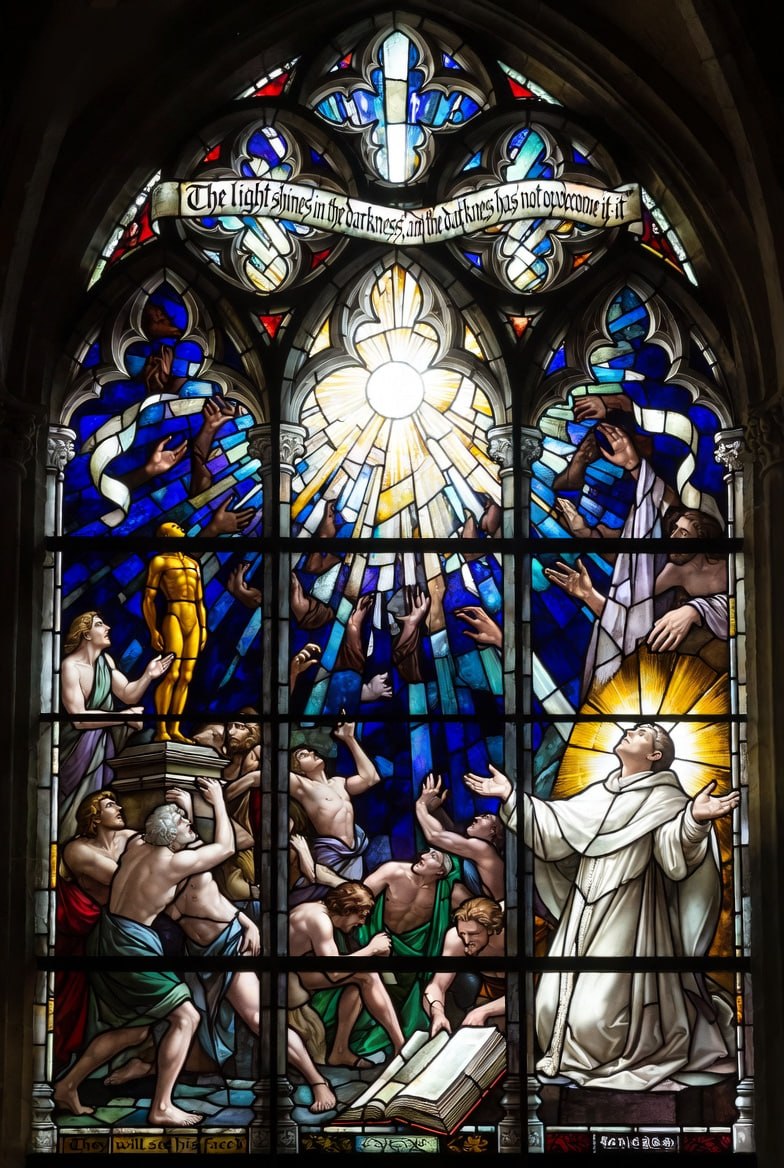
The uncreated Light exceeds human grasp, while idolatry, theological mastery, and mystical surrender are exposed beneath its radiance.
I. Exegesis of John 1:5: The Dynamics of Katalambanō
To understand why the ultimate theological masterpiece of the medieval world had to be abandoned, one must examine the specific linguistic architecture of John’s prologue. In writing “καὶ τὸ φῶς ἐν τῇ σκοτίᾳ φαίνει, καὶ ἡ σκοτία αὐτὸ οὐ κατέλαβεν” (John 1:5), the Evangelist deploys the versatile Greek verb καταλαμβάνω (katalambanō). Derived from kata (down, thoroughly) and lambanō (to take or seize), the word carries a dynamic tension that single English translations routinely fail to capture.
           THE DUAL NATURE OF ΚΑΤΑΛΑΜΒΑΝΩ
              ┌────────────────────────┐
              │      καταλαμβάνω       │
              └───────────┬────────────┘
                          │
         ┌────────────────┴────────────────┐
         ▼                                 ▼
[ MILITARY / PHYSICAL ] [ COGNITIVE / CONCEPTUAL ]
“To Overcome / Overtake” “To Grasp / Comprehend”
• To quench the Light • To enclose within a definition
• To master by force • To possess through intellect
Historically and textually, katalambanō operates on two simultaneous planes:
- The Physical/Military Plane (To Overtake/Overwhelm): It denotes a predatory stalking, an assault, or a darkness hunting a light to choke it out. This is why many modern translations read: “the darkness has not overcome it”.
- The Cognitive/Conceptual Plane (To Grasp/Comprehend/Possess): It means to mentally wrap one’s arms around an idea, to thoroughly master a subject, or to successfully enclose a concept within the boundaries of human definition. (We see Paul use it this way in Ephesians 3:18: “to comprehend… what is the breadth and length and height and depth”).
When John applies this word to the Incarnate Word (Logos), he is establishing a permanent law of cosmic economics: The Divine Light is inherently ungraspable by the systems of this world. The darkness can neither physically extinguish it through violence, nor can it conceptually imprison it within human intellect.
Idolatry is born precisely within this cognitive shadow. Idolatry is the prideful delusion that human beings can successfully achieve katalambanō over the Almighty. It is the fallen human mind attempting to build an intellectual or physical net fine enough to capture, hold, and possess the uncreated Light. When Thomas Aquinas experienced his vision in Naples, he did not discover that his theology was flawed; rather, he ran headlong into the ontological reality of John 1:5. He realized that the Summa was an incredibly sophisticated attempt to conceptually “lay hold of” the Light, but the Light, by its very nature, refuses to be possessed by human grammar.
- The Lethal Attraction of the Face of God
The corporate panic of the human race when confronted by this ungraspable Light is etched across the wilderness narrative of Sinai. In Exodus 33:18, Moses cries out with a desperate, holy boldness: “Please show me your glory.” The divine response establishes an absolute boundary for mortal flesh: “You cannot see my face, for man shall not see me and live” (Exodus 33:20).
Standard historical commentaries frequently interpret this warning as a declaration of physical hazard—as though the sheer energetic radiance of Yahweh would disrupt a mortal heart. Yet, when synthesized with John’s theology of the Light, a far more profound reality emerges: to behold the transcendent majesty of God is to experience something so exhaustively, devastatingly perfect that the temporal realm instantly loses all density, appeal, and validity. The “death” that occurs upon seeing the face of God is not the violent cessation of biological function; it is the lethal beauty of absolute fulfillment that permanently suffocates the soul’s appetite for a localized, mortal existence.
THE RESPONSE TO UNGRASPABLE LIGHT ┌──────────────────────────────────────────────┐
│ The Transcendent Light Breaks In │
│ (John 1:5 / Sinai) │
└──────────────────────┬───────────────────────┘
│
┌─────────────┴─────────────┐
▼ ▼
┌─────────────────────────┐ ┌─────────────────────────┐
│ THE IDOLATROUS RECOIL │ │ THE MYSTICAL SURRENDER │
│ • Attempt to “Grasp” │ │ • Yield to the Light │
│ (καταλαμβάνω) │ │ • Senses paralyzed │
│ • Build a manageable │ │ • Language collapses │
│ representation │ │ into “Straw” │
└─────────────────────────┘ └─────────────────────────┘
When God shielded Moses in the cleft of the rock, covering him with His hand while His “goodness” passed by (Exodus 33:22), He was protecting Moses from an attraction so fierce that remaining tethered to the earthly realm afterward would become an unendurable exile. Whenever the Transcendent ruptures the temporal veil across Sacred Scripture, human faculties immediately buckle under the weight:
- When Isaiah beheld the Lord sitting upon a throne, high and lifted up, his response was a cry of structural unmaking: “Woe is me! For I am lost; for I am a man of unclean lips” (Isaiah 6:5).
- When Ezekiel witnessed the appearance of the likeness of the glory of the Lord, his intellect experienced a total sensory shutdown: “I fell upon my face” (Ezekiel 1:28).
- On the Mount of Transfiguration, when Christ’s garments became white as light, Peter, James, and John were so disoriented by the ungraspable proximity of the divine essence that they spoke incoherently, “not knowing what he said” (Luke 9:33), structurally overwhelmed yet desperately wishing to build temporal shelters to trap the glory.
This is the precise biblical backdrop for Aquinas’s ecstasy. Thomas had spent his life dictating to multiple secretaries at once, acting as an unstoppable intellectual engine. But when the ungraspable Light of John 1:5 flooded his mind during Mass, his capacity for conceptual representation was entirely eclipsed. The “longing for oneness” took over completely. He spent his final three months in a state of quiet detachment, waiting to be released from what you beautifully called the “mortal realm of suffering and death.” His words, “I await the end of my life,” echo your exact point: this world had lost all its flavor.
- Idolatry: The Pride of Compression
To fully appreciate the holiness of Aquinas’s silence, it must be contrasted with the defining spiritual pathology of human history: idolatry. Scripturally, idolatry is the systemic, prideful refusal to leave the Light ungrasped. It is the desperate psychological recoil of a creature who cannot bear the weight of the Transcendent, choosing instead to compress God into the narrow, comfortable, predictable dimensions of the temporal realm.
The Apostle Paul diagnoses this cognitive inversion with terrifying clarity in Romans 1:21-25. He writes that humanity, although they knew God, “did not honor him as God or give thanks to him, but they became futile in their thinking, and their foolish hearts were darkened.” The immediate architectural consequence of this darkening is an exercise in false representation: “and exchanged the glory of the immortal God for images resembling mortal man and birds and animals and creeping things” (Romans 1:23).
| Spiritual Axis | The Johannine Light (The Vision) | The Idolatrous Representation |
|---|---|---|
| Linguistic Posture | Refuses Katalambanō (Cannot be enclosed). | Demands Katalambanō (Captured and frozen). |
| Cognitive Effect | The collapse of human concepts into silence (“Straw”). | The proliferation of confident, static images. |
| The Will’s Posture | Total surrender to an unmediated, lethal Beauty. | Total control over a localized, predictable object. |
| Ultimate Outcome | Worship in Spirit and in Truth (John 4:24). | Exchanging the truth of God for a lie (Romans 1:25). |
Idolatry is born out of a profound fear of the very dynamic Moses encountered. Because man cannot look upon the unveiled face of God and retain control over his mortal life, he builds an image that has no face. The idolater demands a god who can be looked at without the viewer being completely unmade in the process.
This is precisely what occurred at the base of Sinai while Moses was atop the mountain experiencing the dark cloud of the divine presence. The people grew terrified of the silent, invisible Transcendent and cried out to Aaron: “Up, make us gods who shall go before us. As for this Moses, the man who brought us up out of the land of Egypt, we do not know what has become of him” (Exodus 32:1). The resulting golden calf was a tragic exercise in temporal representation—a localized, visible object that could be managed, paraded, and possessed.
The prophets consistently mocked idols not only for their spiritual wickedness, but for their absolute ontological emptiness. Isaiah describes the sheer absurdity of the craftsman who cuts down a cedar tree, burns half of it in the fire to bake bread, and “of the rest he makes a god, his idol, and falls down to it and worships it” (Isaiah 44:15-17). The tragedy of the idol is its total lack of transcendence; it is a closed loop of human projection. The Psalmist notes the terrifying psychological consequence of this worship: “Those who make them become like them; so do all who trust in them” (Psalm 115:8). By worshiping a representation that is deaf, dumb, and inanimate, the human soul systematically shrinks, losing its capacity for the infinite and becoming as hollow as the wood it carved.
- Worshiping in Spirit and in Truth: The Destruction of the Shadow
When Jesus sat by Jacob’s well with the Samaritan woman, He definitively drew the battle line between the temporal geography of representation and the transcendent reality of true worship. He declared: “The hour is coming, and is now here, when the true worshipers will worship the Father in spirit and truth, for the Father is seeking such people to worship him. God is spirit, and those who worship him must worship in spirit and truth” (John 4:23-24).
To worship “in spirit and in truth” is to completely abandon the security of the visible, temporal anchor. It is to recognize that no earthly mountain, no gilded temple, and no humanly devised philosophical system can ever fully contain or accurately represent the living God. The author of the Epistle to the Hebrews spent chapters demonstrating that the entire Old Testament sacrificial framework—with its tabernacle, altars, and blood of goats and bulls—was merely a “shadow of the good things to come instead of the true form of these realities” (Hebrews 10:1). The earthly sanctuary was a necessary placeholder, a divine accommodation to human weakness, but it was never intended to be the final destination.
THE ARCHITECTURE OF SUPERSEDURE
[ Earthly Shadows ] ──────► [ The Incarnate Word ] ──────► [ The Beatific Vision ]
Hebrews 10:1 John 1:14 Revelation 22:4
“Shadow of good”We have seen “They will see
things to come” his glory” his face”
The catastrophic error of religious systems occurs when the shadow is mistaken for the substance—when the representation is transformed into an idol. When human beings become more defensive of their theological definitions, their liturgical structures, or their intellectual achievements than they are surrendered to the living, ungraspable Light of the Almighty, they have committed the very sin Paul condemns in Romans 1. They have attempted to execute katalambanō upon the Creator, exchanging Him for a creaturely tool.
Aquinas’s sudden, absolute silence was a profound act of biblical worship in spirit and in truth. For decades, his mind had wrestled with the deep things of God, producing an unparalleled structural architecture of theological thought. But when Christ directly confronted him from the crucifix—asking, “What reward will you have from me?”—Thomas’s response was entirely devoid of intellectual vanity: “Nothing but Yourself, Lord.”
He did not ask for the completion of his book; he did not ask for historical legacy. He recognized that his millions of written words were merely the scaffolding outside a palace. When the door of the palace swung open and he caught a glimpse of the King in His beauty (Isaiah 33:17), Thomas did not try to domesticate the vision by turning it into more text. He stepped away from the scaffolding, let his hands fall empty, and allowed his intellect to be completely paralyzed by a joy that exceeded all human utterance. He refused to let the Summa become an idol; he chose instead to let it remain a broken monument to the absolute, unsearchable transcendence of God.
Conclusion: The Eschatological Dawn
The ultimate destiny of the human soul is not an eternal seminar of theological analysis, but an eternity of unmediated sight. The Book of Revelation brings the entire biblical narrative to its triumphant, quiet climax in the description of the New Jerusalem: “They will see his face, and his name will be on their foreheads. And night will be no more. They will need no light of lamp or sun, for the Lord God will be their light” (Revelation 22:4-5).
In that final, eschatological state, all representations will be permanently dissolved. There will be no temple in the city, “for its temple is the Lord God the Almighty and the Lamb” (Revelation 21:22). The sun and the moon—the primary temporal markers of this present passing age—will be rendered obsolete, swallowed up by the uncreated light of the divine essence.
             THE PERMANENT ECLIPSE
  Temporal Shadows               Transcendent Reality
┌───────────────────────────┐ ┌───────────────────────────┐
│ • Liturgical Scaffolding │ │ │
│ • Theological Texts │ ──► │ THE BEATIFIC VISION │
│ • Human Definitions │ │ “They will see his face”│
│ • Created Concepts │ │ │
└───────────────────────────┘ └───────────────────────────┘
Rendered OBSOLETE Swallowed up in LIGHT
When Thomas Aquinas looked upon the Host in the chapel in Naples and felt his mortal appetite die within him, he was simply experiencing an early, violent dawn of this eschatological reality. He caught a glimpse of the Face that Moses was shielded from, the Face that the prophets groaned to see, and the Face that every human heart is naturally wired to chase through the dark labyrinth of earthly desire.
His silence is an eternal, prophetic warning to every theologian, every scholar, and every believer who would dare to build a home in the mortal realm. It reminds us that our highest intellectual frameworks, our most beautiful icons, and our most sophisticated dogmas are, at their very best, nothing more than holy straw. They are meant to be burned away by the fire of the divine presence. To truly follow the trajectory of biblical revelation is to live with a sacred, incurable homesickness—a realization that we are citizens of another country, wayfarers in a land of shadows, awaiting the day when all representations will break, all icons will shatter, and we will finally be consumed by the lethal, everlasting beauty of the true and living God who refuses to be grasped.