The Ordo Salutis and the Architecture of Cosmic Reconciliation
Source: raw/The_Ordo_Salutis_and_the_Architecture_of_Cosmic_Reconciliation.pdf
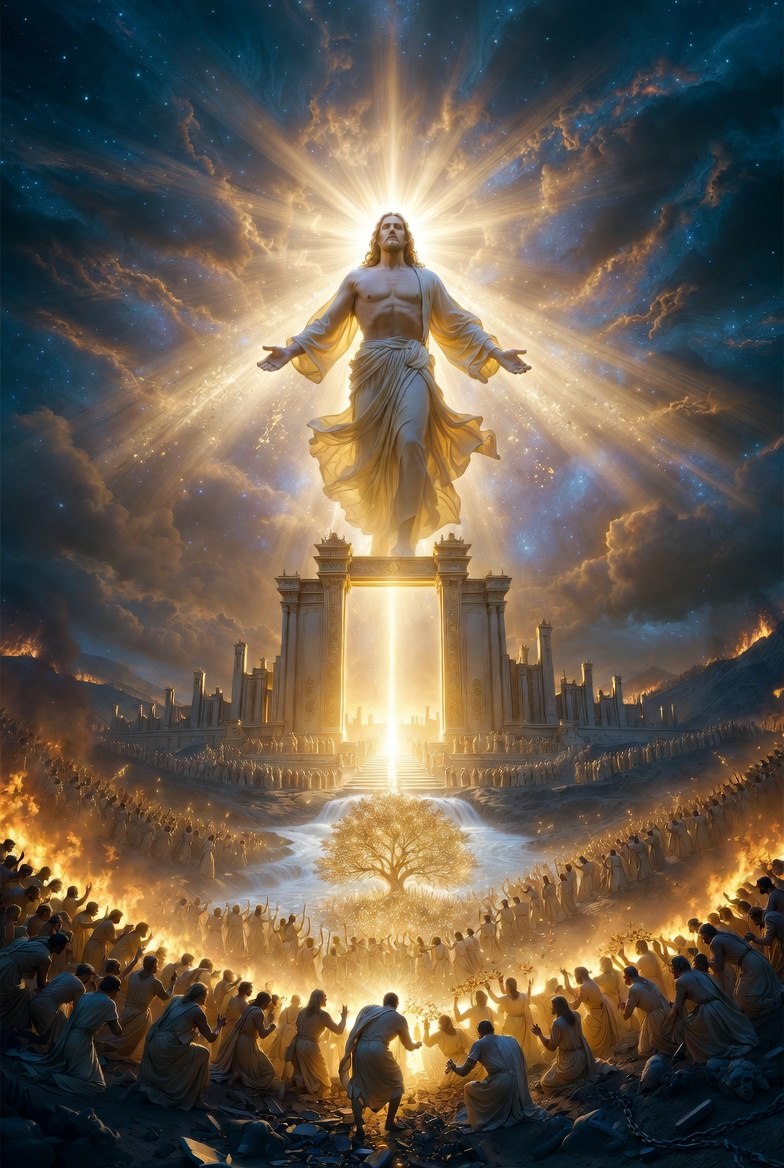
A Scriptural Examination of Salvation Accomplished by Christ and Realized Through Unfeigned Allegiance
A careful study of scripture maintains that salvation constitutes the sovereign and gracious work of the Triune God, accomplished objectively and cosmically by Jesus Christ in His incarnation, sinless obedience, atoning death, bodily resurrection, ascension, and present intercession, securing the reconciliation of all things to God. It is realized subjectively in human lives through the Spirit’s agency as a radical reorientation from a state of enmity, spiritual blindness, and idolatrous illusion to unfeigned covenant allegiance (pistis anhypokritos) to the true Lord of Glory. In the present age, God forges a remnant of firstfruits—the elect—who come to know Him with intimate, participatory knowledge (ginōskō) and are thereby prepared to function as a royal priesthood. In the ages to come, this priesthood participates in the administration of restorative, age-bounded judgment, applying the healing resources of the New Jerusalem to the nations until every knee bows and every tongue renders heartfelt allegiance, resulting in God becoming all in all. This architecture leaves no remainder because the victory belongs entirely to Christ from beginning to end, the required human response is a Spirit-enabled loyalty that admits clear scriptural tests, and the consummation is secured by divine oath and the firstfruits principle embedded in the canonical witness.
I. Introduction: The Crisis of Salvation and the Nature of the Question
Scripture opens the human story with a declaration of created goodness followed immediately by rebellion that fractures the relationship between God and humanity. The apostle Paul summarizes the resulting condition with precision: the mind of the flesh is hostility toward God and is not able to submit to His law (Romans 8:7). The same apostle elsewhere describes those outside Christ as dead in trespasses and sins, following the course of this world and the prince of the power of the air (Ephesians 2:1–3). This enmity is not merely behavioral but ontological and epistemological: the god of this age has blinded the minds of unbelievers so that they cannot see the light of the gospel of the glory of Christ (2 Corinthians 4:4). Consequently, any account of salvation must address both the objective removal of the barrier erected by sin and the subjective transformation of hostile wills and darkened understandings.
The ordo salutis—the order or logical sequence in which God applies the benefits of Christ’s redemptive work—has traditionally been articulated as a chain beginning with election or foreknowledge and culminating in glorification. While such schematizations possess heuristic value, they risk presenting salvation as a series of discrete transactions rather than a unified divine action that reorients the entire person from enmity to allegiance and from illusion to true knowledge. The present examination therefore treats the ordo salutis as the dynamic, Spirit-orchestrated process by which God moves individuals from the condition described above into covenant loyalty that can be tested by clear scriptural criteria and that participates in the larger cosmic trajectory of reconciliation.
Methodologically, the argument proceeds by tracing progressive revelation across the canon, attending to original-language vocabulary at each decisive juncture, and allowing the cumulative weight of universal and particular texts to interpret one another. The trajectory begins with the particular promises made to Abraham and moves outward until the scope of redemption encompasses every creature under heaven and under the earth. Judgment language is examined in its linguistic and contextual particularity rather than through later dogmatic filters. The role of the elect is located within this expanding movement as firstfruits whose present forging equips them for future priestly service. The result is an integrated account in which salvation is shown to be accomplished entirely by Christ, realized through testable allegiance in the present age, and guaranteed to reach its appointed telos in the restoration of all things.
II. Salvation Accomplished: Christ’s Objective, Cosmic Victory
The foundation of the entire architecture is the objective work of Christ. Paul declares that as through one trespass condemnation came to all men, so through one act of righteousness justification and life came to all men (Romans 5:18). The parallel is exact in scope: the “all” who die in Adam correspond to the “all” who receive life in Christ. Likewise, “as in Adam all die, so also in Christ shall all be made alive” (1 Corinthians 15:22). These statements do not describe a potential or hypothetical benefit; they announce an accomplished fact whose realization unfolds according to God’s appointed order and timing.
The epistle to the Colossians supplies the most comprehensive statement of cosmic scope: “For in him all the fullness of God was pleased to dwell, and through him to reconcile to himself all things, whether on earth or in heaven, making peace by the blood of his cross” (Colossians 1:19–20). The phrase “all things” (ta panta) is unqualified. The reconciliation is accomplished “by the blood of his cross,” indicating that the cross itself possesses efficacy extending to every realm of created reality. Hebrews 2:9 reinforces the point by stating that Jesus tasted death “for everyone” (hyper pantos). First Timothy 2:6 describes the same event as “a ransom for all” (antilytron hyper pantōn). These texts collectively establish that the redemptive act is not limited in its objective achievement.
First Timothy 4:10 further nuances the relationship between universal provision and particular experience: God is “the Savior of all people, especially of those who believe.” The adverb “especially” (malista) does not restrict the preceding universal claim; in Pauline usage it identifies a focused subset within a larger, already-included group. The same term appears in 2 Timothy 4:13, where Paul asks for “the books, and especially the parchments,” without implying that the books are to be left behind. Similarly, Galatians 6:10 commands doing good “to everyone, and especially to those who are of the household of faith.” In each case the larger category remains intact while a particular group within it receives emphatic attention. Applied to 1 Timothy 4:10, the text affirms that God is the actual Savior of all people, with believers experiencing the reality of that salvation in the present age as firstfruits who are being prepared for a distinctive vocational role.
The resurrection constitutes the public vindication of this universal achievement. Paul argues that if Christ has not been raised, believers remain in their sins and those who have fallen asleep in Christ have perished (1 Corinthians 15:17–18). The resurrection therefore functions not merely as a future hope for individuals but as the demonstration that the cross has successfully dealt with the power of death that entered through Adam. Because death entered through one man and affected the entire race, the resurrection of the one man Christ Jesus carries implications for the entire race. The apostle’s logic in Romans 5 and 1 Corinthians 15 is that the scope of the remedy must correspond to the scope of the disease.
Thus the objective ground of salvation is universal in its achievement. Christ has reconciled all things, tasted death for everyone, and been raised as the firstfruits of those who sleep (1 Corinthians 15:20). The question that remains is how this objective victory is subjectively realized in human lives and how the present age relates to the ages that follow.
III. Progressive Revelation: The Expanding Scope of God’s Redemptive Purpose
Scripture does not present the universal scope of redemption as an abrupt innovation in the New Testament; rather, it unfolds through a series of expansions that progressively enlarge the circle of those embraced by divine promise. The first expansion appears in the Abrahamic covenant itself. God promises that Abraham’s offspring will be as numerous as the dust of the earth (Genesis 13:16), the stars of heaven (Genesis 15:5), and the sand on the seashore (Genesis 22:17). Early interpreters, including the apostle Paul, discerned a dual reference in these metaphors: the “dust” and “sand” evoke the vast company of earthly humanity, while the “stars” suggest a heavenly or angelic dimension. Paul exploits this distinction when he contrasts the man of dust (Adam) with the man of heaven (Christ) and declares that believers will bear the image of the heavenly man (1 Corinthians 15:47–49). The promise therefore already gestures beyond a merely ethnic or geopolitical people toward a transformed humanity that participates in a higher order of existence.
The second expansion occurs in the prophetic literature, where salvation is depicted as centripetal: the nations stream toward Zion to receive instruction. Isaiah 2:2–3 envisions the mountain of the house of the Lord established as the highest of the mountains, with all the nations flowing to it that they may be taught the ways of the Lord. Isaiah 56:7 extends the temple’s purpose: “My house shall be called a house of prayer for all peoples.” Genesis 12:3 supplies the underlying principle: in Abraham “all the families of the earth shall be blessed.” These texts maintain the centrality of Israel while redefining its vocation as a conduit rather than a cul-de-sac of grace.
The third expansion occurs in the ministry of Jesus and John the Baptist. John warns the crowds not to presume upon physical descent from Abraham, declaring that God is able from these stones to raise up children to Abraham (Matthew 3:9; Luke 3:8). The wordplay between “stones” (abanim) and “children” (banim) severs covenant membership from biological lineage. Jesus Himself announces, “And I, when I am lifted up from the earth, will draw all people to myself” (John 12:32). The verb “draw” (helkyō) carries connotations of powerful attraction or even dragging, as when a net full of fish is hauled ashore. The statement is unqualified: all people are the object of this drawing.
The fourth expansion appears at Pentecost and in the subsequent mission of the church. The Spirit is poured out on all flesh, and the gospel is to be proclaimed in Jerusalem, Judea, Samaria, and to the end of the earth (Acts 1:8). Peter explicitly invokes the restoration of all things (apokatastasis pantōn) as the appointed time when God will send the Christ who is now in heaven (Acts 3:21). Paul universalizes the principle: there is neither Jew nor Greek, for all are one in Christ Jesus (Galatians 3:28), and those of faith are the true sons of Abraham (Galatians 3:7). The wall of hostility has been broken down, creating one new man in place of the two (Ephesians 2:14–16). The direction of movement has reversed: grace now flows outward from Jerusalem to claim the nations.
The fifth and final expansion encompasses the entire created order. Paul states that as in Adam all die, so in Christ shall all be made alive, with each in his own order (1 Corinthians 15:22–23). He envisions a sequence in which Christ reigns until He has put all enemies under His feet, the last enemy being death itself (1 Corinthians 15:24–26). When all things have been subjected to Him, the Son Himself will be subjected to the Father, “that God may be all in all” (1 Corinthians 15:28). Philippians 2:10–11 supplies the corresponding worship: at the name of Jesus every knee will bow—in heaven, on earth, and under the earth—and every tongue confess that Jesus Christ is Lord. The spatial language (“under the earth”) reaches into the realm of the dead, indicating that the confession is not limited to those alive at the parousia. Colossians 1:20 has already announced the reconciliation of all things, whether on earth or in heaven. The trajectory that began with a single family thus terminates in the subjection and voluntary allegiance of every creature.
IV. The Ordo Salutis in the Present Age: From Enmity to Unfeigned Allegiance
The present age constitutes the period in which God calls out and forges the remnant that will serve as firstfruits for the eventual reconciliation of the whole. The process begins with the same condition described earlier: hostility and blindness. God intervenes by causing light to shine in the heart (2 Corinthians 4:6), an act of new creation parallel to the original fiat lux. This illumination is accompanied by a powerful drawing that overcomes resistance (John 6:44). The result is a fundamental reorientation of the will.
The classic text for the subjective response is Romans 10:9–13. Paul writes that if one confesses with the mouth that Jesus is Lord and believes in the heart that God raised Him from the dead, one will be saved. The confession is not bare verbal repetition; the underlying Greek verb homologeō carries the sense of saying the same thing, agreeing publicly, and entering into covenant alignment. Paul grounds this act in two Old Testament passages. Joel 2:32 declares that whoever calls on the name of the Lord will be saved; by applying the title “Lord” (Kyrios) directly to Jesus, Paul identifies Jesus with Yahweh. Isaiah 45:23 supplies the deeper background: God swears by Himself that to Him every knee shall bow and every tongue shall swear allegiance (šābaʿ in Hebrew). The Septuagint renders the Hebrew verb with exomologeō, the same root Paul employs in Romans 10:9. Thus the New Testament confession is the fulfillment of the Old Testament oath of loyalty. To confess Jesus as Lord is to perform the prophetic action of bending the knee and swearing ultimate allegiance to the covenant God now revealed in Christ.
This allegiance stands in sharp contrast to any facsimile or domesticated version of Christ. Jesus Himself warns that not everyone who says “Lord, Lord” will enter the kingdom; many will claim to have prophesied, cast out demons, and performed mighty works in His name, only to hear the declaration, “I never knew you; depart from me, you workers of lawlessness” (Matthew 7:21–23). The issue is not the correctness of the vocabulary but the retention of personal sovereignty. These individuals used the name of Jesus as a tool for their own purposes rather than surrendering to His absolute lordship. Paul issues a parallel warning against receiving “another Jesus” (allon Iēsoun) than the one proclaimed by the apostles (2 Corinthians 11:4). Deuteronomy 13:1–5 provides the ancient diagnostic: even if a prophet performs a sign or wonder that comes to pass, if he calls the people after other gods whom they have not known, the people are not to listen. The test is whether ultimate allegiance remains with the revealed character and commands of Yahweh. Signs and wonders are not self-authenticating; they can coexist with a shifted center of loyalty.
The transition from enmity to allegiance therefore involves both an internal breaking of the hostile will and an external, public oath of loyalty. The internal dimension is captured by the language of being drawn (helkyō) and having light shine into the heart. The external dimension is captured by the confession that Jesus is Lord, understood against the background of Isaiah 45:23 as an act of covenant submission. This is not a transaction that can be reduced to mental assent; it is the surrender of one’s ultimate definition of reality, morality, and authority to the risen Lord of Glory.
V. Knowing the True Christ: Diagnostics of Genuine Faith
Because the possibility of a facsimile Christ exists, Scripture supplies clear tests by which genuine allegiance may be distinguished from its counterfeit. The First Epistle of John is devoted almost entirely to this diagnostic task. Three interrelated tests emerge.
The first is moral: “By this we know that we have come to know him, if we keep his commandments. Whoever says ‘I know him’ but does not keep his commandments is a liar, and the truth is not in him” (1 John 2:3–4). The verb “know” here is ginōskō, which denotes participatory, covenantal intimacy rather than the mere possession of information. The same epistle later states that anyone who does not practice righteousness is not of God, nor is the one who does not love his brother (1 John 3:10). Obedience is not the ground of salvation but the necessary evidence that genuine covenant relationship exists.
The second test is relational: “Anyone who does not love does not know God, because God is love” (1 John 4:8). And again, “If anyone says, ‘I love God,’ and hates his brother, he is a liar” (1 John 4:20). Love here is not sentimental affection but the concrete disposition that mirrors the self-giving of Christ, who laid down His life for His enemies (Romans 5:10). A religion that permits or encourages hatred or exploitation of others reveals that its object is not the true God revealed in Christ.
The third test is Christological: “Every spirit that confesses that Jesus Christ has come in the flesh is from God, and every spirit that does not confess Jesus is not from God” (1 John 4:2–3). The confession is not merely that a divine Christ appeared to assume a temporary human form; it is that the eternal Son took to Himself a real human nature and lived a real human life under the conditions of the present age. This test excludes both docetic denial of the incarnation and any reduction of Jesus to a merely human teacher whose ethical insights may be selectively appropriated.
These tests converge on the distinction between two Greek verbs for knowing. The verb oida refers to factual, cognitive apprehension—the knowledge of data or recognition of identity from a distance. Demons possess flawless oida: they recognize Jesus as the Holy One of God and the Son of God (Mark 1:24; Luke 4:41) and even believe that God is one, yet they shudder (James 2:19). Their knowledge produces terror, not allegiance. In contrast, ginōskō denotes experiential, relational, participatory knowledge—the kind of knowing that occurs in covenantal union. Jesus defines eternal life as knowing (ginōskōsin) the only true God and Jesus Christ whom He has sent (John 17:3). Paul corrects himself in Galatians 4:9: believers have come to know God, or rather to be known by God. The primary reality is God’s sovereign recognition and claim upon the person. First Corinthians 8:3 adds that if anyone loves God, he is known by God; love and being known are inseparable.
When Jesus declares to the religious performers of Matthew 7:23, “I never knew you” (oudēpote egnōn hymas), He uses the aorist of ginōskō. He does not deny that they possessed factual information about Him or that they had performed works using His name. He denies that any covenantal intimacy or mutual knowing ever existed. Their allegiance remained with their own religious performance and retained sovereignty. The ordo salutis therefore includes not only the initial transition from enmity to confession but also the ongoing verification that the confession is unfeigned (anhypokritos). Paul speaks of “sincere faith” (pisteōs anhypokritou, 1 Timothy 1:5) and a faith that is “sincere” (anhypokritou pisteōs, 2 Timothy 1:5). The term anhypokritos literally means “without a mask,” evoking the ancient theatrical practice of speaking through a persona. Genuine faith drops the mask and presents the actual self to the actual Christ in unfeigned loyalty.
VI. The Remnant Priesthood: Vocational Election and Firstfruits
Within the present age God does not call every individual into the same relationship to the unfolding restoration. He calls out a remnant whose present experience of salvation equips them for a distinctive future role. Paul addresses this directly in Romans 9–11. After expressing anguish over the large-scale rejection of the Messiah by ethnic Israel, he insists that God has not rejected His people whom He foreknew (Romans 11:2). He appeals to the precedent of Elijah: in a time of national apostasy God preserved seven thousand who had not bowed the knee to Baal (1 Kings 19:18; Romans 11:4). “So too at the present time there is a remnant, chosen by grace” (Romans 11:5). The Greek term leimma denotes the residue or scrap left over after the main fabric has been cut. The remnant is not the totality but the concentrated, purified core.
This remnant is further identified as firstfruits. James writes that God brought believers forth “by the word of truth, that we should be a kind of firstfruits of his creatures” (James 1:18). Paul employs the same principle in Romans 11:16: “If the dough offered as firstfruits is holy, so is the whole lump, and if the root is holy, so are the branches.” The Old Testament background appears in Numbers 15:17–21, where the first portion of the dough is offered to God as holy; by this act the entire remaining harvest is declared holy and acceptable. Applied to the present age, the existence of a holy remnant does not imply that the rest of humanity is abandoned; it functions as the legal and spiritual guarantee that the whole lump will ultimately be brought into the same holiness.
The vocational purpose of the remnant is priestly. Peter describes believers as “a chosen race, a royal priesthood, a holy nation, a people for his own possession” (1 Peter 2:9). A priest stands between God and those who are far off in order to mediate reconciliation. The elect are not chosen merely for their own blessedness but to serve as the instrument through which the reconciliation accomplished by Christ is administered to the rest of creation in the ages to come. Their present forging through testing and suffering prepares them for this weight of glory (2 Corinthians 4:17; Romans 8:18). The remnant is therefore both the first installment of the restored humanity and the priestly core commissioned to facilitate the restoration of the whole.
VII. Judgment in the Coming Ages and the Ministry of Restoration
The transition from the present age to the consummation passes through a period of judgment whose character must be determined by the same linguistic and contextual controls that govern the rest of the argument. Three key terms require careful examination.
The adjective aiōnios (and the noun aiōn) does not inherently denote endless duration. It means “pertaining to an age” or “age-enduring.” The Septuagint uses aiōnios for institutions that came to an end, such as the Aaronic priesthood (Numbers 25:13) and the old covenant itself. Jonah describes his time in the fish as “forever” (aiōn), yet it lasted three days and nights (Jonah 2:6). The term therefore designates the quality and source of an event or state—its belonging to the coming age of divine action—rather than its chronological infinity.
The noun kolasis in Matthew 25:46, traditionally rendered “punishment,” carried in classical Greek the specific sense of remedial or corrective discipline, as when a parent or teacher prunes or trains for improvement. It stands in contrast to timōria, which denotes purely retributive vengeance. Jesus’ choice of kolasis for the age-enduring judgment of the goats aligns with a remedial purpose.
The Lake of Fire is described as burning with brimstone or sulfur (theion). In ancient Greek the same term denoted that which is divine or pertains to deity (theos). Sulfur was used in religious ritual to fumigate, consecrate, and purify. A “lake of divine sulfur” is therefore a crucible of divine purification rather than a chamber of arbitrary torment. Paul supplies the controlling analogy in 1 Corinthians 3:15: if anyone’s work is burned up, he will suffer loss, “though he himself will be saved, but only as through fire.” The fire destroys what is false and combustible while preserving the person.
The spatial imagery of Revelation 21–22 further clarifies the nature and purpose of this judgment. The gates of the New Jerusalem are never shut (Revelation 21:25). Nothing unclean enters, yet the kings of the earth—previously seen in rebellion (Revelation 19)—bring their glory into the city (Revelation 21:24). Those outside are described as dogs, sorcerers, the sexually immoral, murderers, and idolaters (Revelation 22:15), yet the leaves of the tree of life are “for the healing of the nations” (Revelation 22:2). Inside the city there is no more pain, crying, or death (Revelation 21:4); therefore the nations requiring healing must be those located outside. The river of the water of life flows from the throne through the middle of the street and out toward the surrounding regions, echoing Ezekiel 47 where waters flow from the temple to bring life to the dead sea. The geography implies an ongoing ministry of restoration in which the resources of the perfected community are applied to those still undergoing correction. The elect, now glorified and exercising their royal priesthood, participate in this ministry.
The verb apollumi, often translated “destroy” or “perish,” does not necessitate annihilation or irreversible loss. In the parables of Luke 15 the lost sheep is sought until found, and the prodigal son “was lost and is found.” The wineskins that burst are ruined in their original form but not reduced to nonexistence (Matthew 9:17). When applied to final judgment, apollumi indicates the shattering of the old, rebellious identity so that the underlying person can be reclaimed and remade.
Taken together, these linguistic and contextual data indicate that the judgment of the coming age(s) is real, severe, and purifying rather than merely retributive or annihilative. It serves the larger purpose of removing every false allegiance and illusion so that the confession of Jesus as Lord can be rendered with unfeigned integrity by every tongue.
VIII. The Consummation and Realization in Our Lives
The sequence reaches its appointed end when Christ has put all enemies under His feet, the last of which is death (1 Corinthians 15:24–26). At that point the Son delivers the kingdom to the Father “that God may be all in all” (1 Corinthians 15:28). The phrase “all in all” (panta en pasin) signifies the absence of any remainder, any sphere, or any creature still existing in alienation or illusion. Every knee in heaven, on earth, and under the earth has bowed, and every tongue has confessed with heartfelt allegiance that Jesus Christ is Lord (Philippians 2:10–11; Isaiah 45:23). This is not a forced or external submission; the vocabulary of exomologeō and the surrounding context of voluntary praise indicate that the allegiance is genuine because the rebellious identity has been fully purged.
In the present age this future reality is already being realized in the lives of those who have been called into the remnant. The ordo salutis unfolds as a coherent sequence. God shines the light of the knowledge of His glory into the heart (2 Corinthians 4:6), drawing the person out of blindness and hostility (John 6:44; 12:32). The will is broken and reoriented toward the true King. Public confession with the mouth that Jesus is Lord enacts the oath of allegiance (Romans 10:9). This allegiance is tested and verified by the criteria of 1 John: obedience that flows from covenant intimacy, love that mirrors Christ’s self-giving, and confession of Jesus Christ come in the flesh. The faith that survives these tests is unfeigned (anhypokritos), without mask or retained sovereignty.
Assurance arises from both the objective and subjective poles. Objectively, it rests on the finished work of Christ, whose victory is total and whose oath secures the end. Subjectively, it is confirmed by the Spirit’s ongoing production of the fruit that 1 John identifies as diagnostic. The believer does not look inward for a mystical experience of election but outward to Christ and to the transformed life that His Spirit produces. Participation in the royal priesthood begins now: believers are already a holy nation and royal priesthood (1 Peter 2:9), offering spiritual sacrifices and proclaiming the excellencies of the One who called them out of darkness into light. This present vocation is the training ground for the greater ministry that awaits in the ages of restoration.
Thus the ordo salutis in the present age is not an isolated transaction whose sole purpose is the individual’s escape from judgment. It is the forging of a priestly core whose present experience of unfeigned allegiance equips them to serve as instruments of the very reconciliation that Christ has objectively secured for all.
Conclusion
The architecture traced above integrates every dimension of the scriptural witness. Salvation is accomplished by Christ in a single, sufficient, cosmic act whose scope is coextensive with the effects of Adam’s trespass. It is realized in the present age through a Spirit-enabled movement from enmity and illusion to unfeigned covenant allegiance that admits clear, repeated scriptural tests. The elect remnant functions as firstfruits whose present forging prepares them for priestly participation in the restorative judgment of the coming ages. That judgment, examined in its original linguistic and contextual setting, serves a purifying rather than merely retributive purpose, consistent with the larger trajectory that moves from particular promise to universal restoration. The consummation is the voluntary, heartfelt confession of every creature that Jesus Christ is Lord, professing allegiance, resulting in God being all in all.
This account leaves no doubt in the mind of the believer because every stage is grounded in the explicit declarations of Scripture, the universal statements are not severed from their actual realization, the warnings of judgment are honored in their severity while being located within a remedial purpose, and the end is secured by the same divine oath that undergirds the entire redemptive movement. The believer is therefore summoned to the present response of unfeigned allegiance, tested loyalty, and priestly vocation, knowing that this response participates in the certain triumph of the Lamb who was slain and who reigns until every enemy is subdued and every tongue confesses His lordship.