The Path of Re-Embodiment
The Path of Re-Embodiment names the movement of return from false embodiment into Christ.
It asks how spirit takes flesh, how entrusted good becomes possessed, and how persons, churches, institutions, and nations become embodied under another lord.
The Path is held together with The Keeping of the Troth and The Measure of Christ. The Keeping asks what faithful response must become in the body; The Measure asks whether every act of diagnosis, protection, and repair remains answerable to Christ.
It begins with a simple confession: every spirit seeks flesh. Every flesh reveals a spirit. What we love becomes visible in what we repeatedly do, protect, fund, excuse, ritualize, and sacrifice for.
The Movement
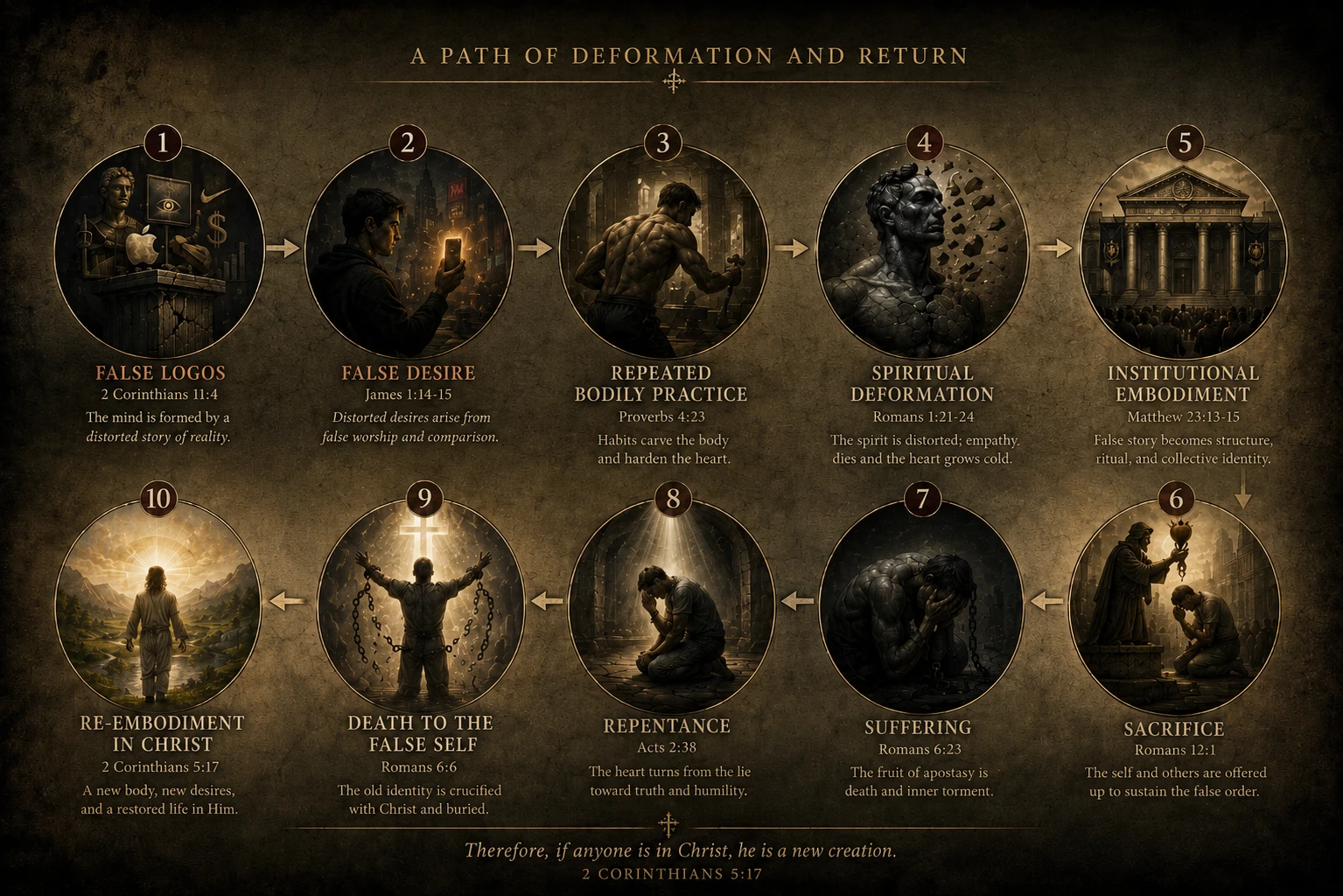
False Logos
A false logos does not need to announce itself as rebellion. It can appear as prudence, respectability, preservation, tradition, efficiency, safety, success, or maturity.
The first work is discernment: what ordering word is shaping the body?
False Desire
The false logos trains desire. It teaches the person or institution what to fear, what to protect, what to pursue, and what loss would feel unbearable.
Repeated Practice
Desire becomes bodily through repetition. Habits, rituals, policies, schedules, budgets, technologies, liturgies, and speech patterns become the training ground of the soul.
Spiritual Deformation
The body does not remain neutral. Repeated practice forms the inner life. A person or institution begins to call deformation wisdom because the false shape has become familiar.
Institutional Embodiment
Private deformation becomes public architecture. The false logos receives offices, titles, legal forms, donor systems, monuments, membership processes, and disciplinary mechanisms.
Sacrifice
Every embodied order asks for sacrifice. It may demand money, silence, reputation, labor, bodies, children, enemies, scapegoats, or truth itself.
Suffering
Christ exposes false embodiment through suffering. The moment of loss reveals what has been functioning as lord.
Repentance
Repentance turns the whole body. It changes the mind, but also the practice, the allegiance, the economy, the speech, and the willingness to lose what cannot be carried into Christ.
Death to the False Self
The false body cannot be politely improved into resurrection. It must die. The believer, the church, and the institution must surrender the form that preservation built.
Re-Embodiment in Christ
The end is not accusation. The end is Christ.
Re-embodiment is the Spirit reforming the whole person and the whole people into the life of the Logos: truthful, sacrificial, merciful, disciplined, repentant, and alive.